English
 中文简体
中文简体
Apr 02,2026
What Are Vinyl Sheet Piles and How They Differ From Steel Alternatives
Vinyl sheet piles are interlocking structural panels manufactured from rigid polyvinyl chloride (PVC) compound, designed to be driven or pressed into soil to form continuous retaining walls, bulkheads, seawalls, and erosion control barriers. Like their steel counterparts, vinyl sheet piles are produced with interlocking edges — typically a ball-and-socket or tongue-and-groove profile — that connect adjacent sheets into a continuous, soil-retaining barrier. However, the material properties of vinyl create a product with a fundamentally different performance envelope compared to steel, with distinct advantages in corrosion resistance, weight, and lifecycle cost, alongside different limitations in structural load capacity and installation technique.
The adoption of vinyl sheet piling has grown substantially since its commercial introduction in the 1980s, particularly in waterfront and coastal construction where the corrosion of steel sheet piles in marine environments represents a significant long-term maintenance liability. In saltwater, brackish water, and chemically aggressive soils, unprotected steel sheet piles can lose structural section through corrosion at rates of 0.1 to 0.3 mm per year or more, requiring expensive cathodic protection systems, coatings, or periodic replacement. Vinyl sheet piles, being chemically inert to the environments in which they are most commonly installed, offer a maintenance-free alternative that retains its structural properties indefinitely in the same conditions that rapidly degrade unprotected steel.
Material Composition and Mechanical Properties of Vinyl Sheet Piling
The structural performance of vinyl sheet piles depends critically on the formulation of the PVC compound used in their manufacture. Unlike flexible PVC used in pipes or cable insulation, vinyl sheet piling is produced from rigid, unplasticized PVC (uPVC) or, in some formulations, modified PVC compounds that incorporate impact modifiers to improve toughness without significantly reducing stiffness. The compound formulation determines the pile's flexural modulus, tensile strength, impact resistance, and long-term creep behavior under sustained loading.
Key Mechanical Properties
Standard vinyl sheet pile compounds exhibit a flexural modulus of 2,500 to 3,500 MPa, compared to approximately 200,000 MPa for steel. This means that vinyl sheet piles deflect significantly more than steel piles of equivalent section under the same lateral earth or water pressure loading — a factor that must be explicitly accounted for in structural design using deflection-limited design criteria rather than strength-limited criteria, which typically govern steel pile design. Tensile strength of uPVC sheet pile material is typically 45 to 55 MPa, with elongation at break of 50 to 150%, providing ductile behavior that prevents sudden brittle fracture under overload conditions.
UV Stabilization and Long-Term Durability
Unprotected PVC degrades under prolonged ultraviolet radiation exposure, leading to surface embrittlement, color fading, and progressive loss of impact resistance. Vinyl sheet piles intended for above-ground or partially exposed installations — such as seawalls, dock walls, and garden retaining walls — must incorporate UV stabilizer packages, most commonly titanium dioxide (TiO₂) as a UV-reflective pigment combined with organic UV absorbers. Quality vinyl sheet pile products carry documented UV stabilization ratings that specify minimum acceptable retained impact strength after defined periods of accelerated weathering testing to standards such as ASTM G154 or ISO 4892-2.
Chemical and Biological Resistance
One of the defining advantages of vinyl sheet piles over steel and even timber alternatives is their resistance to the full spectrum of chemically and biologically aggressive environments encountered in civil construction. Vinyl sheet piles are immune to corrosion in saltwater, brackish water, and freshwater, resist attack from dilute acids and alkalis, are not subject to marine borer attack (unlike timber piling), and do not support the growth of iron-oxidizing bacteria that accelerate steel corrosion in waterlogged soils. This chemical inertness is the primary driver of vinyl sheet pile adoption in marine, tidal, and contaminated land applications.
Profile Types and Section Properties of Vinyl Sheet Piles
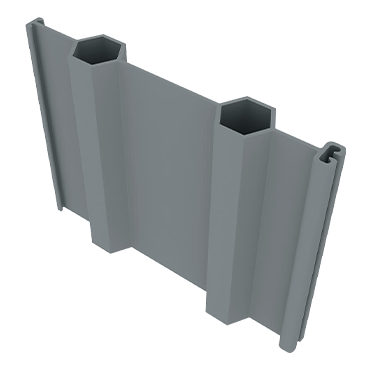
Vinyl sheet piles are produced in several cross-sectional profile geometries, each optimized for different load levels, installation conditions, and application types. The selection of profile type is the primary structural design decision in any vinyl sheet pile application, as it determines the section modulus and moment of inertia available to resist bending from lateral earth and water pressures.
| Profile Type | Typical Width | Section Modulus | Typical Application |
| Flat / Low-profile | 300–500 mm | 50–150 cm³/m | Light erosion control, garden walls |
| Z-profile | 400–600 mm | 200–500 cm³/m | Moderate retaining walls, bulkheads |
| Deep arch / U-profile | 500–750 mm | 400–900 cm³/m | Seawalls, dock walls, higher loads |
| Combi-wall / H-profile | Variable | Up to 1,200+ cm³/m | Heavy marine structures, high walls |
| Tongue-and-groove flat | 200–400 mm | 30–100 cm³/m | Landscape, pond liners, light barriers |
The Z-profile and deep arch profiles deliver the highest section modulus per unit width and are therefore the most commonly specified vinyl pile types for structural retaining and bulkhead applications. The interlocking mechanism in these profiles is engineered to maintain interlock continuity under differential loading between adjacent piles, which would otherwise open gaps in the wall and allow soil or water leakage. Interlock tightness and the tensile capacity of the interlock itself — typically 150 to 400 kN/m for structural vinyl profiles — are important specification parameters that are often overlooked in budget product comparisons.
Primary Applications of Vinyl Sheet Piles in Civil and Marine Construction
Vinyl sheet piles are most competitive with steel and concrete alternatives in applications where corrosion resistance, low self-weight, or environmental considerations are primary drivers. The following application categories represent the core market for vinyl sheet piling in civil engineering and waterfront construction.
Seawalls and Coastal Erosion Control
Coastal and estuarine seawall construction is the largest application segment for vinyl sheet piles. In tidal and splash zones, steel sheet piles are subject to accelerated corrosion driven by the combination of oxygen availability, chloride ion concentration, and wetting-drying cycles — conditions that can reduce pile thickness by 0.5 mm or more per year without corrosion protection. Vinyl sheet piles eliminate this corrosion risk entirely, providing a maintenance-free barrier with a design service life exceeding 50 years in marine environments. They are particularly well-suited to residential waterfront properties, marinas, and small harbor protection works where the capital cost of steel pile cathodic protection systems is disproportionate to the project scale.
Bulkheads and Dock Walls
Boat dock bulkheads, canal walls, and small craft harbor retaining structures represent a high-volume application for vinyl sheet piles. These structures typically require retained heights of 1.5 to 4.0 meters — well within the structural capability of Z-profile and deep arch vinyl piles when properly designed with adequate embedment depth and, where required, tie-back anchoring to reduce bending moment at the pile head. The light weight of vinyl piles — typically 10 to 25 kg per linear meter of pile, compared to 50 to 150 kg/m for steel equivalents — significantly reduces the equipment required for installation, enabling many small dock and bulkhead projects to be completed with lighter, lower-cost installation rigs.
Flood Defense and Canal Lining
Vinyl sheet piles are used in flood defense embankment toe protection, flood wall construction, and canal or drainage channel lining. In these applications, the hydraulic impermeability of the interlocked vinyl wall is as important as its structural function — the wall must prevent seepage of floodwater or canal water through the barrier. Vinyl interlock connections, when properly installed, provide effective water cut-off performance, with seepage rates measurably lower than equivalent steel pile installations where corrosion-induced crevice formation at interlocks compromises long-term hydraulic performance.
Contaminated Land and Environmental Barriers
In brownfield remediation and contaminated land management, vinyl sheet piles serve as subsurface vertical barrier walls that contain contaminant migration through groundwater. The chemical resistance of uPVC to a broad range of organic and inorganic contaminants — including petroleum hydrocarbons, chlorinated solvents, and heavy metal leachates at concentrations typically found in contaminated ground — makes vinyl an appropriate barrier material where steel or concrete would be subject to chemical degradation. For contaminated land applications, the interlock sealing performance is critical, and grout-injected or sealant-filled interlocks are often specified to ensure hydraulic continuity of the barrier.
Installation Methods and Ground Suitability for Vinyl Sheet Piles
The installation of vinyl sheet piles requires careful attention to ground conditions, installation equipment selection, and driving technique to avoid pile damage. Vinyl piles are considerably more susceptible to installation damage than steel piles, and improper installation is the most common cause of premature structural failure in vinyl sheet pile installations.
- Vibratory hammer installation: The preferred installation method for vinyl sheet piles is a vibratory hammer, which uses high-frequency vibration to liquefy the soil temporarily around the pile tip and allow penetration with minimal driving resistance. Vibratory hammers minimize the impact stress transmitted to the pile and are compatible with the lower impact strength of vinyl compared to steel. Hydraulic vibratory hammers with adjustable eccentric moment allow precise control of the driving energy to match soil resistance.
- Static pressing: In sensitive urban environments where vibration must be minimized, hydraulic press-in machines can install vinyl sheet piles by applying static crowd force without vibration. This method requires higher crowd force than vibratory installation in most soil types but generates negligible ground-borne vibration, making it suitable for installation adjacent to existing structures, utilities, or vibration-sensitive infrastructure.
- Pre-augering in dense soils: In gravelly, dense, or cobble-bearing soils, vinyl sheet piles cannot be directly driven or vibrated to depth without risk of tip damage or pile buckling. Pre-augering — drilling a pilot hole to the required penetration depth before inserting the pile — is required in these ground conditions to avoid pile damage and ensure the pile reaches its design embedment depth.
- Water jetting assistance: In fine-grained sandy soils, high-pressure water jetting through a jet pipe attached to the pile face can fluidize the soil ahead of the pile tip, reducing driving resistance. Water jetting is an effective and low-cost technique for accelerating vinyl pile installation in suitable soil conditions but must be controlled to avoid over-jetting that could compromise the embedment density around the pile and reduce passive resistance.
Structural Design Considerations Specific to Vinyl Sheet Piles
Designing with vinyl sheet piles requires a different analytical approach compared to steel pile design, primarily because of the material's lower stiffness, significant creep behavior under sustained loading, and temperature-dependent mechanical properties. Engineers transitioning from steel pile design must adapt their design methodology to account for these vinyl-specific characteristics.
Creep — the time-dependent increase in deformation under constant sustained load — is a significant design consideration for vinyl sheet piles that has no meaningful equivalent in steel design. Under sustained lateral earth or water pressure loading, a vinyl sheet pile wall will continue to deflect slowly over time even after initial elastic deflection is complete. The magnitude of long-term creep deflection depends on the stress level in the pile cross-section, the temperature, and the duration of loading. Reputable vinyl pile manufacturers provide long-term creep reduction factors — typically 0.5 to 0.7 applied to short-term modulus values — that must be incorporated into deflection calculations for permanent retaining structures.
Temperature effects are also more significant for vinyl than for steel. The flexural modulus of uPVC decreases by approximately 30 to 40% as temperature increases from 10°C to 40°C, meaning that a vinyl pile wall designed to a specific maximum deflection at a northern European mean annual temperature may exhibit significantly greater deflection during summer months in warmer climates. Design should use the modulus value corresponding to the maximum expected service temperature, not the ambient installation temperature, to ensure that deflection limits are not exceeded under the most adverse thermal conditions encountered during the structure's service life.
Comparing Vinyl Sheet Piles to Steel and Fiberglass Alternatives
Understanding where vinyl sheet piles sit relative to steel and fiberglass (FRP) alternatives helps project teams make well-informed material selection decisions based on the specific requirements of each application.
- Vinyl vs. steel: Steel sheet piles offer significantly higher section modulus and stiffness, enabling taller retained heights and heavier loading without tie-back anchoring. However, steel requires corrosion protection in marine and aggressive environments, adding cost and maintenance obligations. Vinyl is the preferred choice for low-to-moderate retained heights in corrosive environments where long-term maintenance-free performance is valued over maximum structural capacity.
- Vinyl vs. fiberglass (FRP): FRP sheet piles offer higher stiffness and strength than vinyl at similar section dimensions, with comparable corrosion resistance. However, FRP piles carry a significant cost premium — typically 2 to 4 times the unit cost of vinyl piles — limiting their use to applications where the structural requirements exceed vinyl's capability but where corrosion precludes steel. Vinyl remains the dominant choice for the broad middle ground of marine and waterfront retaining applications.
- Vinyl vs. timber: Timber sheet piles — particularly hardwood species — were widely used in waterfront construction before the adoption of vinyl. Timber is subject to marine borer attack, fungal decay in alternating wet-dry conditions, and dimensional instability. Vinyl has largely displaced timber in most applications where long service life and low maintenance are required, except in specialized ecological or heritage contexts where natural materials are mandated.